
Self & Growth
The Cost Of Comparison
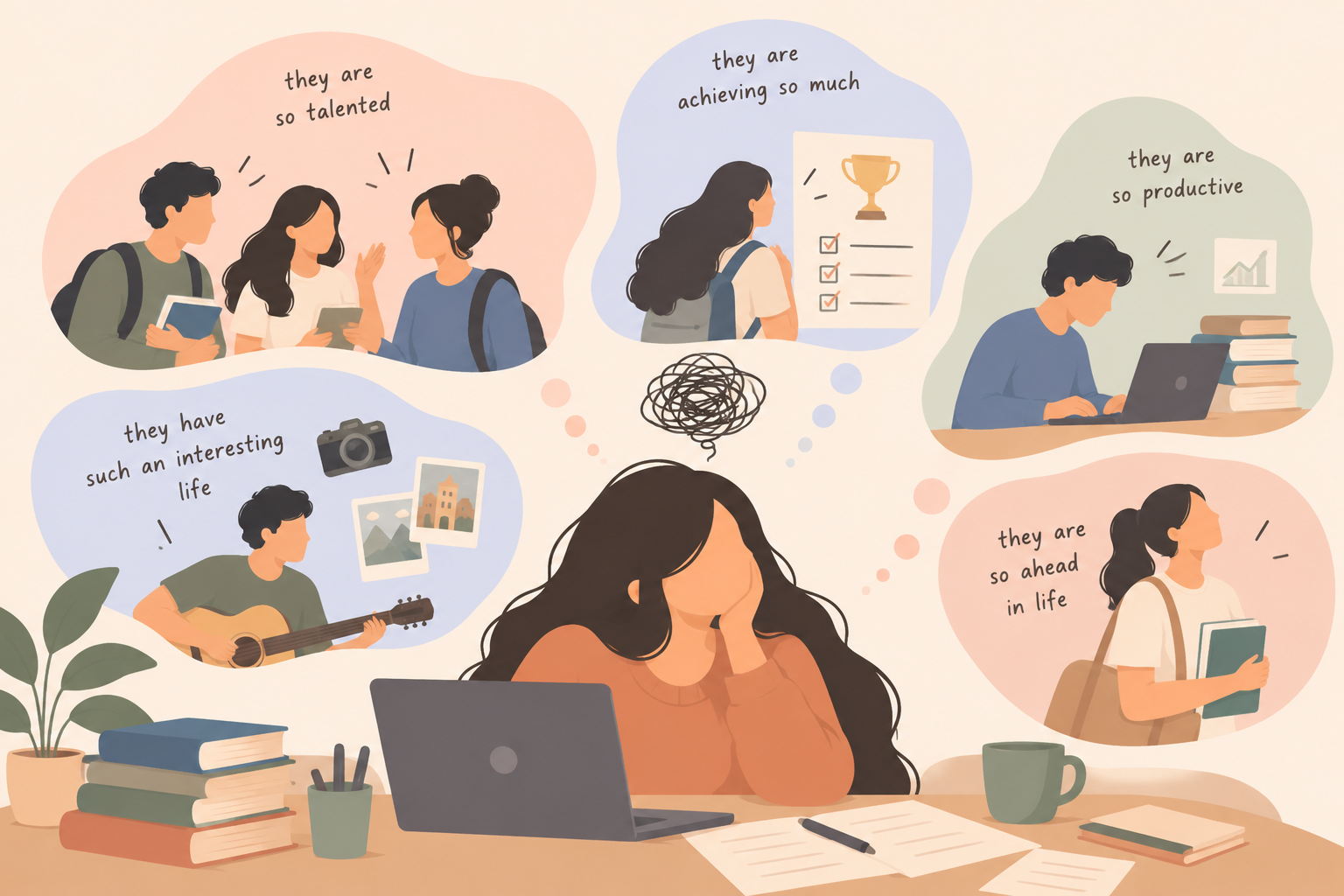
Have you ever asked yourself, “Why am I still not there yet?” “Why have I not achieved it yet?” because someone you know achieved something? And you know what comes next: the classic question, “Am I not good enough?” and a continuous loop of self-doubt and overthinking.
This is a typical example of comparison and its effects.
But why do we compare ourselves to others?
See, comparison is an evolutionary instinct; our ancestors used to compare themselves to decide their ranks, and so do we. But slowly, this habit of comparison has become a vicious cycle.
But still, the question remains: “Why do we compare ourselves?”
The habit of comparison develops for various reasons, such as competition: when you realise you’re not the only one in the race; Parents: when your parents compare you with other kids; society: when everyone around you has a rank for everyone; academic pressure: the pressure to excel; and, most importantly, seeing only the achievements of others.
What is the problem with comparison?
The problem with comparison is that you compare your Behind-the-scenes with someone else’s Highlight reel. You do not think of their struggles and hard work, and what it took them to achieve what they have now; you only see the centre stage, the place they have achieved.
First and foremost, you need to realise that everyone has their own struggles, strengths, resources, and, above all, timeline. Everything takes time, and everything has its own timeline. You can not and should not compare your day 1 with someone else’s day 100th.
How does comparison affect you?
Comparison affects you in ways you’ve never counted,
- It makes you doubt your own abilities
- Creates unnecessary pressure
- Can turn someone else's success into your failure
- Makes you focus more on competition than growth
- And takes away satisfaction from your own progress.
So, you know it’s true when people say, “Comparison is a thief of joy”.
Is comparison always bad?
No! Not every comparison is bad. Healthy comparison can motivate you to work harder and inspire you to become better. It can also improve your productivity and efficiency. But the problem begins when it makes you feel inadequate or incapable, rather than motivated.
What can you do instead?
Firstly, you should not think of getting rid of the habit of comparison. Why? Because healthy comparison allows us to know how much better we have become, where we stand, and how far we have to go.
Secondly, you can compare yourself to your past self; you can keep a journal to track your performance, so that every time you see someone’s success and start doubting yourself, you have a record that shows your hard work. You can learn from people instead of competing with them, and you can also limit social media comparison.
How does Biyani Group of Colleges Help?
Biyani College treats everyone equally, with no partiality. Biyani does celebrate its students’ victories but does not let others feel behind. The college sees the efforts and struggles of every student and guides them in their journey by conducting sessions on personal growth, motivation, and self-development, like the Bhagavad Gita Session and Motivational sessions conducted by Dr Sanjay Biyani, who is the Academic Director, motivational speaker and a youth motivator.
So, focus on becoming better than the person you were yesterday. Celebrate your own progress, encourage healthy competition, and most importantly, remember:
Someone else being ahead of you doesn’t make you fall behind!